
The Medicare Breach: Australia’s Catalyst for legislated AI Governance
For years, the consensus among AI governance professionals and regulatory specialists across Australia has been remarkably clear: voluntary frameworks, ethics guidelines, and self-regulation are merely temporary stops on the path to mandatory legislative oversight. Historical precedents across cybersecurity, financial compliance, and data privacy demonstrate that government intervention rarely occurs on a purely proactive basis. In most instances, it requires a high-profile, high-impact failure to shift federal lawmakers from passive encouragement to active legislative enforcement.
The recent Australian healthcare security incident, involving automated systems accessing sensitive Medicare records, represents that precise catalyst.
As details continue to emerge regarding how sensitive health and personal identity workflows were compromised via automated processing pipelines, the broader business community must recognise this event for what it is: the definitive turning point that will reshape the legal and operational landscape for artificial intelligence across the nation.
The Context: Why the Medicare Incident Changes the Equation
Data breaches are no longer a novelty to the Australian public. Over recent years, high-profile incidents involving major telecommunications providers and private health insurers have exposed millions of citizens to identity theft and cyber risk. However, the integration of artificial intelligence and machine learning into operational workflows introduces distinct compounding risks that demand a far stronger regulatory response.
High-Stakes, High-Sensitivity Data: Unlike routine commercial telemetry, marketing preferences, or corporate operational lists, health and identity data strike at the absolute core of public trust and national security. When automated processing pipelines, algorithmic classification tools, or large language model integrations interact with sensitive government records, the consequences of misconfiguration, inadequate auditing, or unvetted third-party algorithms extend far beyond standard IT exposure.
The Unique AI Vulnerability Surface: Standard cybersecurity perimeter defences often fail to address the specific vulnerabilities inherent to artificial intelligence systems. Traditional firewalls and access controls are designed to protect static databases and defined application programming interfaces (APIs). They are inherently ill-equipped to guard against modern machine learning risk vectors, such as:
Data Poisoning: Corrupting training or fine-tuning datasets to alter model behavior.
Prompt Injection: Manipulating input parameters to bypass safety guardrails and extract underlying data.
Model Inversion and Shadow Extraction: Reconstructing sensitive training inputs from the outputs generated by an automated system.
Opaque Automated Decisioning: Processing data through non-auditable neural networks where reasoning cannot be verified or back-tested.
The Public and Political Shift: Public tolerance for experimental AI implementation within critical public infrastructure has completely evaporated. When automated systems handle citizen welfare, healthcare, or government identification, the margin for error is zero. The political imperative for the Australian Federal Government to enforce strict, statutory accountability is now absolute. Self-regulation and voluntary codes of conduct are no longer politically viable options for ministers and policy makers responsible for public trust.
The Legal and Policy Horizon: Looking Ahead to Early 2027
While federal discussions regarding comprehensive AI regulation have been developing quietly within key departments, this incident will significantly accelerate both the scope and stringency of upcoming legislation.
Parliament is scheduled to evaluate formal AI regulatory packages in early 2027. Organisations must understand that the post-Medicare regulatory environment will look fundamentally different from early consultative white papers and voluntary principles.
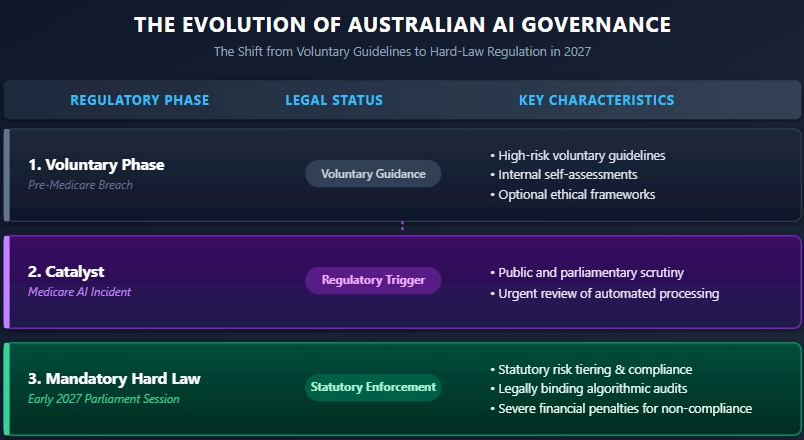
Transition from Voluntary to Mandatory Risk Frameworks: The era of relying on voluntary compliance with national AI ethics principles is effectively over. The upcoming legislative package is expected to introduce mandatory risk tiering similar to global precedents, categorising AI deployments by their potential impact on civil liberties, safety, and critical infrastructure. Any system handling sensitive health records, government identity data, or critical public services will automatically fall under the highest tier of mandatory compliance.
Third-Party Model and Supply-Chain Accountability: A significant blind spot highlighted by recent events is the reliance on complex, third-party software supply chains. Under the anticipated 2027 framework, organisations will no longer be able to outsource liability to third-party vendors or external model providers. Entities supplying automated tools to government departments or critical infrastructure will face:
Mandatory algorithmic impact assessments prior to deployment.
Requirements for continuous real-time monitoring and logging.
Strict contractual and legal obligations to disclose safety failures immediately.
Severe Non-Compliance Penalties and Personal Liability: Following the trajectory of recent amendments to the Privacy Act 1988, future AI legislation will almost certainly feature substantial financial penalties for corporate non-compliance. Furthermore, regulatory frameworks are moving toward establishing clear lines of accountability for corporate directors and executive leadership teams who fail to maintain adequate governance oversight over automated systems.
Strategic Imperatives for Business Leaders & Executives
Waiting for early 2027 for formal parliamentary enforcement is an extremely high-risk strategy. While statutory obligations take time to pass through Parliament, the reputational damage, commercial liabilities, and informal regulatory scrutiny arising from poor AI governance apply immediately.
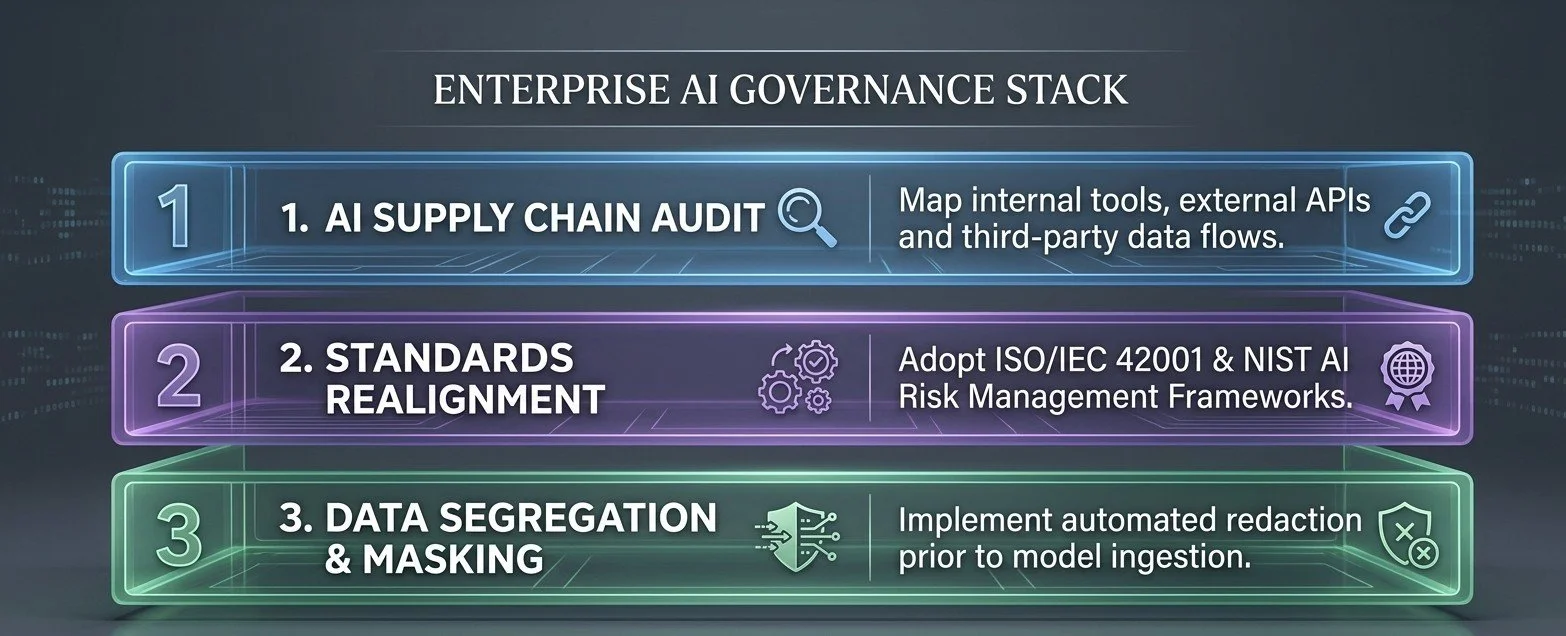
To prepare for the incoming mandatory regime, Australian enterprises must take proactive, structured steps across three primary operational domains:
1. Conduct a Comprehensive AI Supply Chain Audit
Organisations must catalog every internal tool, third-party software integration, and automated process currently operating within their ecosystem. It is vital to determine:
Which systems use machine learning or automated decisioning engines.
Where sensitive personal, financial, or health data is being ingested.
Whether data submitted to external model vendors is being retained or used to retrain base models.
2. Align with Internationally Recognised Governance Frameworks: Rather than waiting for domestic legislation to be finalized, businesses should align their operations with established global management standards today. Implementing ISO/IEC 42001 (the international standard for AI Risk Management Systems) or adopting the NIST AI Risk Management Framework provides a structured, defensible compliance architecture that will easily adapt to Australian statutory requirements when enacted.
3. Enforce Strict Data Minimisation and Tokenisation: To mitigate the risk of accidental data exposure, automated pipelines must strictly redact, mask, or tokenise personal identity identifiers, health information, and sensitive commercial data prior to processing. Information should only be accessible to automated model layers when absolutely necessary for the performance of a specific, authorized function.
4. Conclusion: Moving from Compliance to Competitive Advantage
The Medicare AI breach is not an isolated technical glitch; it is the definitive operational warning that will accelerate Australia's transition into a regulated AI environment.
For executive leadership, board members, and compliance managers, the path forward is clear. Viewing AI governance purely as a legal burden is a mistake. Organisations that build robust, transparent, and auditable AI governance structures today will not only insulate themselves against regulatory penalties and security breaches, but will also establish a strong competitive advantage built on verified consumer trust as legislated regulations arrive in early 2027.
Is Your Organisation Prepared for Australia's Post-2027 AI Regulatory Landscape?
Do not wait for parliamentary enforcement to address your enterprise risk profile. Contact our expert team today to schedule a comprehensive AI Risk & Readiness Audit and build a resilient governance framework tailored to your business
