
Beyond the Hype: Unlocking Enterprise ROI
The corporate landscape is experiencing a profound period of commercial reckoning. Capital expenditure allocated to generative artificial intelligence and advanced machine learning models has reached unprecedented heights globally. Yet, a stark disconnect has emerged between boardroom expectations and actual financial returns.
According to a comprehensive study by the Massachusetts Institute of Technology (MIT) Networked Agents and Decentralised AI (NANDA) initiative, titled The GenAI Divide: State of AI in Business, approximately 95 per cent of custom corporate AI pilots fail to transition into full production or yield a measurable return on investment (ROI). This statistic should serve as an immediate warning to executives who view artificial intelligence as a simple, drop-in software upgrade.
This deficit in returns points to a broader structural issue within enterprise technology strategies. As tech journalist Natasha Bernal recently highlighted on The Tech Report, significant long-term risk exists for organisations that build their core business models or operational dependencies on top of generic, third-party software-as-a-service (SaaS) AI subscriptions. Renting standard application programming interfaces (APIs) fails to create proprietary value, exposes an organisation to volatile pricing structures, and leaves businesses dependent on software infrastructure they do not control.
The underlying data from the MIT research demonstrates that this widespread failure is not a failure of the technology itself, but rather a direct failure of organisational integration. To bridge this divide and join the 5 per cent of organisations generating genuine value, executive leadership must understand and mitigate the three distinct structural culprits identified by the research.
1. The Learning Gap and the Reality of User Abandonment
The first major hurdle identified by the MIT study is the "Learning Gap". Many executives assume that introducing an advanced large language model (LLM) into a department will result in immediate, compounding productivity gains. In practice, standard enterprise LLM implementations prove to be remarkably brittle when subjected to the nuances of daily corporate operations.
Unlike human employees or truly adaptive software platforms, standard generative models are static snapshots. They do not naturally retain context over extended periods, they fail to learn dynamically from ongoing employee feedback, and they require constant, repetitive manual prompting from staff to manage complex edge cases. When a system requires continuous manual intervention just to complete a standard corporate task, it ceases to be an efficiency tool and becomes an administrative burden.
Consequently, frontline employees quickly abandon these tools, quietly reverting to legacy software and manual spreadsheets to ensure accuracy. This user abandonment leaves initial capital investments completely stranded.
To overcome the Learning Gap, organisations must shift away from top-down mandates. True operational alignment requires engaging end-users at the initial configuration stage, ensuring that any deployed system includes structured user-feedback mechanisms that systematically update the underlying corporate knowledge base. Building employee trust involves ensuring that workers see these systems as dependable infrastructure that simplifies their daily workflows rather than as rigid, unpredictable obstacles.
2. The Front-Office Visibility Bias
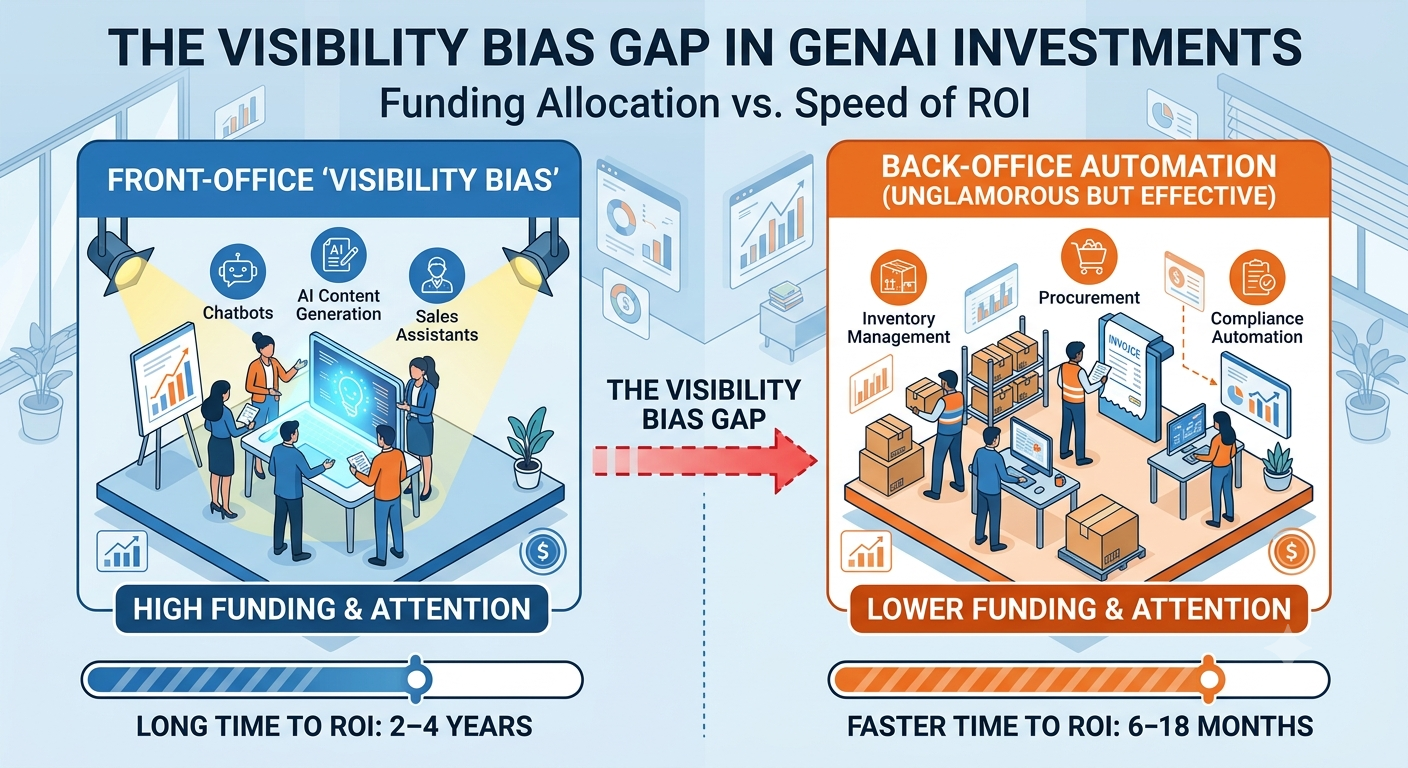
The second major cause of stranded capital is the front-office "Visibility Bias". The MIT research revealed a massive misallocation of corporate funds: more than half of corporate AI budgets are directed toward highly visible, customer-facing applications within sales and marketing departments.
While automated marketing campaigns, front-end content generation, and conversational client interfaces attract significant boardroom attention, they are highly complex to execute responsibly. These client-facing projects require extensive regulatory oversight, present elevated data privacy risks, and face volatile consumer reception. The study found that these high-visibility front-office initiatives typically take between 2 to 4 years to yield any verifiable, scaled economic results.
Conversely, the most immediate financial returns are found in unglamorous back-office automation. Projects focused on streamlining internal administrative workflows, automating data verification, optimising inventory records, and eliminating expensive third-party business process outsourcing (BPO) contracts consistently deliver measurable ROI within 6 to 18 months. Because these internal applications operate within controlled data environments, they involve significantly lower compliance risks and target clear, quantifiable cost centres where efficiency gains can be mathematically audited. Despite this efficiency, back-office initiatives currently receive only a small fraction of overall corporate funding.
3. The Build vs. Buy Trap
The final structural failure point outlined by MIT's data is the "Build vs. Buy" Trap. In an effort to secure an immediate competitive advantage, many corporations attempt to engineer completely custom, in-house AI platforms from the ground up.
MIT’s data indicates that these ambitious internal projects operate with a success rate of only 33 per cent. Internal technical teams frequently underestimate the long-term infrastructure overhead, the complexities of cleaning training data, and the specialised engineering talent required to maintain bespoke models. These initiatives routinely degrade into open-ended, costly internal research projects that fail to align with the core commercial objectives of the business.
In contrast, partnering with specialised external vendors to deploy targeted, vertical enterprise tools yields a 67 per cent success rate. Specialised software vendors bring mature infrastructure, pre-configured security protocols, and industry-specific data frameworks that integrate directly with existing corporate systems. By choosing targeted vertical tools over speculative custom development, organisations drastically compress their time-to-value while avoiding catastrophic engineering overheads.
Blueprints of Success: Responsible Enterprise Deployment in Australia
Rather than relying on theoretical international models, Australian enterprises provide clear examples of how disciplined organisations can navigate these three failure points to achieve definitive fiscal and operational returns.
Financial Risk Mitigation: Commonwealth Bank of Australia
The financial services sector demands absolute data precision and strict compliance. The Commonwealth Bank of Australia (CBA) successfully avoided the Visibility Bias by focusing its technical resources on real-time transaction security and fraud mitigation.
Instead of relying on a generic third-party subscription model, CBA integrated predictive algorithms directly into its secure internal transactional data pipelines. The system securely evaluates thousands of complex data signals per second across the bank's digital payment networks to identify emerging scams and fraudulent activities.
To prevent the common pitfalls associated with the Learning Gap, CBA maintains a strict human-in-the-loop governance structure. Every automated flag and system-generated intercept rule is verified by expert internal fraud analysts. This practical application delivered a substantial reduction in customer fraud losses during recent financial quarters, demonstrating how targeted back-office systems can deliver clear financial protections without exposing the organisation to data sovereignty risks.
Supply Chain and Inventory Logistics: Woolworths Group
In the highly competitive retail sector, supply chain efficiency is directly tied to profit margins. Woolworths Group addressed the visibility challenge by deploying specialised machine learning algorithms entirely within its back-office inventory and replenishment networks.
The system processes vast commercial datasets overnight across 1,400 stores and national distribution centres to provide real-time demand forecasting. By analysing historical purchasing trends, regional weather data, and local logistics patterns, the predictive platform accurately determines exact stock requirements.
This deep integration into the physical supply chain has substantially reduced food waste, optimised warehouse storage costs, and improved product availability on shelves. Woolworths achieved these outcomes by avoiding generic, subscription-based chat interfaces, focusing instead on an integrated, data-driven solution tailored directly to its core distribution operations.
Public Sector Auditing and Governance: The Audit Office of New South Wales
The public sector faces intense scrutiny regarding transparency, data privacy, and accountability. To modernise its document review and public asset analysis, the Audit Office of New South Wales partnered directly with the Commonwealth Scientific and Industrial Research Organisation (CSIRO) through its data specialist division, Data61.
By selecting a specialised partner rather than attempting to build a custom language platform from scratch, the Audit Office avoided the Build vs. Buy Trap. The partnership allowed them to deploy specialised textual analysis models specifically calibrated for public sector accounting and regulatory oversight.
The implementation features strict data containment boundaries to ensure sensitive government records are never exposed to external public commercial networks. This application allows human auditors to isolate financial anomalies and synthesise massive volumes of public expenditure data rapidly, ensuring that every automated insight is fully traceable, auditable, and backed by human judgment.
Actionable Strategy for Executive Leadership
To move an enterprise into the top tier of technology performance and secure a genuine return on investment, executive leadership must enforce structural discipline across all business units:
Audit the Corporate Technology Footprint: Conduct an immediate internal audit to list every active automation pilot, software trial, and unauthorised third-party SaaS subscription currently paid for across individual departments.
Prioritise Back-Office Efficiency: Reallocate capital away from high-visibility front-office experiments toward high-viability back-office processes where systemic friction can be removed and structural expenses can be permanently reduced.
Establish Formal Governance Ownership: Assign direct corporate accountability for data provenance, model accuracy reviews, and regulatory compliance to specific senior executives, maintaining a definitive internal register of all data utilisation.
Realising value from advanced technology does not require chasing broad industry trends or investing in speculative custom platforms. Long-term commercial success belongs to the pragmatists who view these systems not as independent solutions, but as a precise extension of their existing data assets, operational workflows, and human expertise.
Case Study Sources
1. Risk Management and Fraud Mitigation: Commonwealth Bank of Australia
o Official Disclosure: Commonwealth Bank of Australia Media Release, “CommBank releases Australian-first report outlining how it is adopting AI,” published February 2026. LINK
2. Supply Chain and Inventory Logistics: Woolworths Group
o Official Disclosure: RELEX Solutions Corporate Announcement, “RELEX chosen by Woolworths Group to Modernise Replenishment Platform,” published April 2025. LINK
3. Public Sector Governance: New South Wales Government and CSIRO Data61
o Official Disclosure: Commonwealth Scientific and Industrial Research Organisation (CSIRO) Research Briefing, “Redesigning the NSW AI Assessment Framework,” published 2025.
